
Welcome, ECFS families
A healthy mind starts with a healthy body.
Office of Health Services
Primary Contact:
Teddy O'Rourke
Chief Operating Officer
718-329-7590 | torourke@ecfs.org
Quick Links

Dear Families,
Welcome to the ECFS Health Offices! We are delighted to have you join our community focused on promoting the well-being of our students.
At ECFS, we believe that a healthy body and mind are essential for academic success. Our dedicated team of healthcare professionals is here to provide comprehensive support, ensuring that every student thrives both inside and outside the classroom.
This website serves as a valuable resource for you and your family, offering information on health services, programs, and initiatives tailored to meet the unique healthcare needs of our students. From immunizations to concussion support, we have you covered. Explore our site to find important forms, guidelines, contact info, and tips for maintaining a healthy lifestyle.
Thank you for entrusting us with your child's well-being. Together, let's foster a culture of health and wellness in our school community.
Warm regards,
Your School Nurses
Medical Conditions and Forms
Magnus Health
ECFS uses Magnus Health, an electronic medical record service, to collect all medical information for students as well as other parent/guardian signed permission forms. Magnus Health is now accepting medical forms and information for the 2026–2027 academic year. In order to provide our nurses with time to review individual submissions and to communicate any necessary follow up, we ask that all forms be submitted no later than Friday 8/7.
While some of these forms require a physician’s signature, many of the requirements can be submitted completely electronically through the Magnus Health website or mobile application. To begin the process, please access the Magnus Health Portal. If you are logging in for the first time, or are unable to remember your username or password, you can reset them.
All new and returning families should complete the:
- Vital health record (i.e. emergency contacts, physician contact, health history)
- Consent for treatment form
- Athletic consent form, if applicable
- Fall interval health form, if applicable
- Immunization form, as needed
- Inhaler prescription form and the allergy, diabetes, or seizure action plans, if applicable
- Over-the-counter medication form, if applicable
- Prescription medication form, if applicable
New families should also complete the following forms. Returning families should complete the following forms if they are currently expired on your account:
- Physical exam form: Your child’s physical is valid for one year. Once the physical data has been entered, Magnus will send you an alert when the next annual physical is due.
- Eye examination form: This must be completed for rising Kindergarten students or new students entering 1st–5th Grade. This is not required for 7th–12th Grade.
Click here for a tutorial on uploading forms to the website and here for directions to upload forms using the app.
How do I set up biometrics on the mobile app?
Biometrics (Face ID / Touch ID) are now available to access the app. Click here for instructions to enable Biometrics (Face ID / Touch ID) on Apple or Android devices with authentication enabled. For users who do not have devices with biometrics enabled, you can still use the operating system’s password keepers.
If you do not already have the new Magnus app on your phone, please visit the Apple Store or the Google Play store to download the “Magnus Health” application. If you already have the app on your phone, please check the app store to ensure it is updated to the latest version.
Additional questions?
For more information on how to submit requirements, please visit the Magnus Help Desk or contact Magnus at service@magnushealthportal.com or 919-502-7689. For any other questions, please contact Assistant Director of Campus Services, Soraya Falipou-Karkari (sfalipou-karkari@ecfs.org).
Health Policies
Student Medical Services
The role of the school nurse is to support the overall well-being and academic success of our students. The nurse's office institutes health and safety guidelines, provides nursing assessment for any injuries or illnesses, helps students manage chronic illnesses or life-threatening allergies, and assists in health education. In addition, the nurse's office maintains medical records and health information in accordance with the requirements mandated by the NYC Department of Health and Mental Hygiene
ECFS complies with New York State law regarding immunization requirements for students. A record of immunization is required on the school medical form. Effective June 2019, New York State eliminated the religious exemption from immunization. Consistent with the law, ECFS will only permit medical exemptions from immunization. Parents/guardians with questions about immunization requirements should contact the nurse's office within their respective divisions.
The New York State Department of Health Immunization Requirements for School Attendance may be viewed here, with frequently asked questions available here.
Every season brings various contagious illnesses. The circulating and more common viruses in school are colds, conjunctivitis, influenza, stomach bugs, and strep throat. A student must be kept home from school under the following circumstances:
-
As determined and outlined by the COVID-19 Response Team at covid.ecfs.org.
-
A fever of 100°F or higher. When your child has been fever-free for 24 hours (without the use of fever-reducing medication) and has no other symptoms, the student may return to school;
-
Diarrhea or vomiting (that is not from motion sickness or gag-reflex induced) in the past 24 hours; or
-
Influenza – children who have been diagnosed with the flu should stay home and return as ordered by their pediatrician. Please report cases of the influenza virus to the nurse’s office, as we keep track of the number of cases.
-
Students who are diagnosed with fever will be sent home immediately and cannot stay at school for any scheduled test or quiz, rehearsal, or athletic activity.
-
Students who have bacterial infections (such as strep throat) that require antibiotics must be on antibiotics for at least 24 hours prior to returning to school.
This policy is intended to protect the health and welfare of your child and the ECFS community and applies in instances when your child has a scheduled test or quiz, a rehearsal, or athletic activity.
A doctor's note is required after an absence longer than three days, and a family conference may be required when a student has been absent 10 or more days.
Picking Up Children from School
Parents/guardians, or their authorized caregiver, should be available to pick their child up from school within sixty minutes of being notified by their divisional nurse or main office. When on a school sponsored trip or activity, parents/guardians, or their authorized caregiver, understand that they may be required to travel to the trip location to pick up their child at the direction of the School.
The School will notify parents/guardians as soon as a head injury is suspected, and families should report any head injury that did not happen at a school-related activity to the nurse. Parents/guardians are expected to obtain proper medical evaluation and clearance by a licensed healthcare professional with training in concussion evaluation and management. The treating healthcare professional is expected to provide the School with an initial care plan and follow \-up care plans as indicated.
ECFS takes Return-to-Learn and Return-to-Play seriously. In order for a student to return to physical activity without restrictions, appropriate documentation must be received, students must be completely symptom-free, both at rest and during physical and mental exertion, with neurocognitive function within a normal range, and have completed a supervised Return-to-Play protocol. ECFS will not allow the student to participate fully while experiencing any lingering or persisting symptoms of a concussion, no matter how slight.
ECFS students are expected to be completely toilet trained and able to manage their own toileting needs. A student that is toilet trained identifies and communicates the need to use the bathroom, cleans themselves (wipes properly, washes hands, etc.), changes their own soiled clothing, and does not have toileting accidents.
All Pre-K through 2nd Grade students are required to have a change of clothes available to them in their classroom. Parents/guardians are notified when toileting accidents occur and on-campus family assistance may be required. Parent/guardian home-based toilet training will be required should a student be regularly unable to navigate their own sanitary needs. ECFS does not prohibit children from participation in the school day due to single-event toileting accidents. ECFS expects parents/guardians to fully cooperate and coordinate with the classroom teacher, guidance team, and divisional leadership team to minimize the impact on the educational environment.
Parents/guardians are required to provide all requested student medical information and to ensure that the information is current while the student is in attendance at the School. ECFS uses an electronic medical record service, Magnus Health, to collect all medical forms for students. Access the families portal to log into Magnus Health to complete the required online profile, and print/upload physician forms. If your address or contact info is not correct, request changes by emailing infoupdates@ecfs.org. Include your name and relationship to the student, student's name, division, and grade.
For questions regarding Magnus Health, email them at service@magnushealthportal.com or contact their customer support by phone at 919-502-7689. To view the Magnus Health Privacy and Security page, click here.
Medical Examinations
The School requires that parents/guardians submit certain medical information before the student may begin attending classes. All students must have an electronic health record completed in Magnus Health before school begins. Requirements include the Student Vital Health Record (emergency contacts, physician contact, health history), Annual Physical, Immunization Record, Consent to Treatment, and an Over-the-Counter Medication Consent. Additional requirements, if applicable, include action plans for asthma, allergies, diabetes, or seizures, and a Prescription Medication Form for each prescription taken at school.
While some of forms may require a physician’s signature, many of the requirements can be submitted completely electronically through the Magnus Health website or mobile application. Families may also photograph and upload forms through the Magnus app by selecting “Student Health Tracker” and clicking on the title of the respective requirement. In order to provide our nurses with time to review individual submissions and to communicate any necessary follow up, we ask that all forms be submitted by the date prescribed by the school.
Nursing and school offices cannot complete or upload any forms to Magnus Health.
If a teacher suspects a student has a vision problem, the teacher may send the student to the school nurse who will perform a basic vision screening. If there is an identifiable problem, the nurse will make a vision referral.
Scheduling Appointments
The School understands that, from time to time, students may need to be absent from or late to school in order to attend necessary appointments (such as medical or dental appointments). ECFS asks that parents/guardians make every reasonable attempt to minimize disruption to their child’s attendance at school and schedule such appointments for after school hours or days when school is not in session. Aside from emergency responders, medical professionals are not permitted to come to campus to examine students or provide treatment.
Changes in Medical History
Any changes in the students’ health status during the academic year — for example, any illness, medication change, surgery needed, etc. — should be communicated to the school nurses. The school nurses are the first to respond to an emergency situation; therefore, the nurses need to be aware of each student’s complete and current medical history. This information is kept strictly confidential and only shared on a need-to-know basis.
If your student will require prescription medication to be administered during the school day or at school-related activities, ECFS requires that parents/guardians submit written authorization on the ECFS Prescription Medication Form in order for the school nurse to administer such medications. This form must be submitted via Magnus Health prior to the first day of classes. The school nurse cannot give your student medication of any kind without such written authorization.
All medication must be brought to school in the original container received from the pharmacy that contains the dosage, instructions for administration, the prescribing doctor’s name, and the name of the medication. All medications must be left in the nurse's office.
Students are not permitted to carry over-the-counter medications with them during the school day. Parents/guardians who would like their child to receive over-the-counter medication during school hours must provide the school with written authorization through Magnus Health.
In accordance with New York State Regulation: All students must have patient-specific orders from their provider for any OTC medication along with written parent/guardian consent for such medications to be administered to, or taken by their child including school stock OTC.
The school nurse will attempt to contact parents/guardians regarding any serious illness or injury, but in circumstances that warrant immediate attention or when the School is unable to reach the parents/guardians, designated emergency contacts, or the student’s physician, the school nurses will determine the appropriate treatment. In the event of a serious emergency, an ambulance will be called, the student will be taken to the nearest hospital emergency room, and at least one parent will be notified immediately.
Parents/guardians are expected to keep emergency information up-to-date. Please remember, it is critically important that the School have current home, work, and cell phone numbers for parents/guardians or others (relatives, friends, or neighbors) who routinely assume temporary care of the student if the student’s parent(s) cannot be reached.
Parents/guardians will be notified of any illness or injury that may require follow-up medical care. A Consent to Treatment Form must be up to date and on file for every student, allowing the School to render treatment and obtain outside medical assistance when necessary.
In order to make elevators readily available for people with physical mobility disabilities, students may only use the elevators if they have a note from the nurse.
Ethical Culture & Fieldston Lower
Students who are able to come to school but feel a little under-the-weather or have a “walking injury” are expected to report to Physical Education. In these situations, the teacher will determine the appropriate level of student participation.
Students who suffer a more serious injury or illness that will necessitate a prolonged period of healing (three or more days) are required to present the school nurse with a note from a physician that should include either full clearance for participation in Physical Education or the modifications necessary for the student to participate and complete the school’s Physical Education requirements. When a physician’s instructions indicate that a student should not go to Physical Education, the school nurse, Physical Education teacher, and divisional administrator will determine where the student will report during PE.
The student might attend the class in order to take part safely in the activity in another capacity, as a referee for example.
Fieldston Middle & Fieldston Upper
Students who are able to come to school but feel a little under-the-weather or have a “walking injury” are expected to report to Physical Education or Dance and discuss the situation with their teacher. In these situations, the teacher will determine the appropriate level of student participation.
Students who suffer a more serious injury or illness that will necessitate a prolonged period of healing (three or more days) are required to present the school nurse with a note from a physician that should include either full clearance for participation in Physical Education, Athletics, or Dance or the modifications necessary for the student to participate and complete the school’s Physical Education requirements. When a physician’s instructions indicate that a student should not go to Physical Education, the school nurse, Physical Education department chair, and Dean will determine where the student will report during PE. Failure to follow these protocols may result in the student receiving an unexcused absence.
A student must present a note from a doctor to be medically excused from PE for an extended period of time. Under state law, a student who is medically excused from Physical Education classes for longer than six weeks needs to complete an alternative program of physical activity or physical therapy and to present the PE department with evidence of that alternative program.
On October 23, 2025, Governor Kathy Hochul enacted the Jack Reid Law (the Reid Law), amending the New York Education Code to extend certain protections to students attending nonpublic elementary and secondary schools, similar to the public school Dignity for All Students Act (DASA).
The Reid Law provides that “[n]o student shall be subjected to harassment or bullying, including cyberbullying, by other students on school property or at a school function.” It defines “harassment” and “bullying” collectively as the “creation of a hostile environment by [verbal or non-verbal] conduct, or by threats, intimidation, or abuse, including cyberbullying, that
-
has or would have the effect of unreasonably and substantially interfering with a student’s educational performance, opportunities or benefits, or mental, emotional or physical well-being;
-
reasonably causes or would reasonably be expected to cause a student to fear for their physical safety;
-
reasonably causes or would reasonably be expected to cause physical injury or emotional harm to a student; or
-
occurs off school property and creates, or would foreseeably create, a risk of substantial disruption within the school environment, where it is foreseeable that the conduct, threats, intimidation or abuse might reach school property.”
“Cyberbullying” is defined as harassment or bullying that “occurs through any form of electronic communication.”
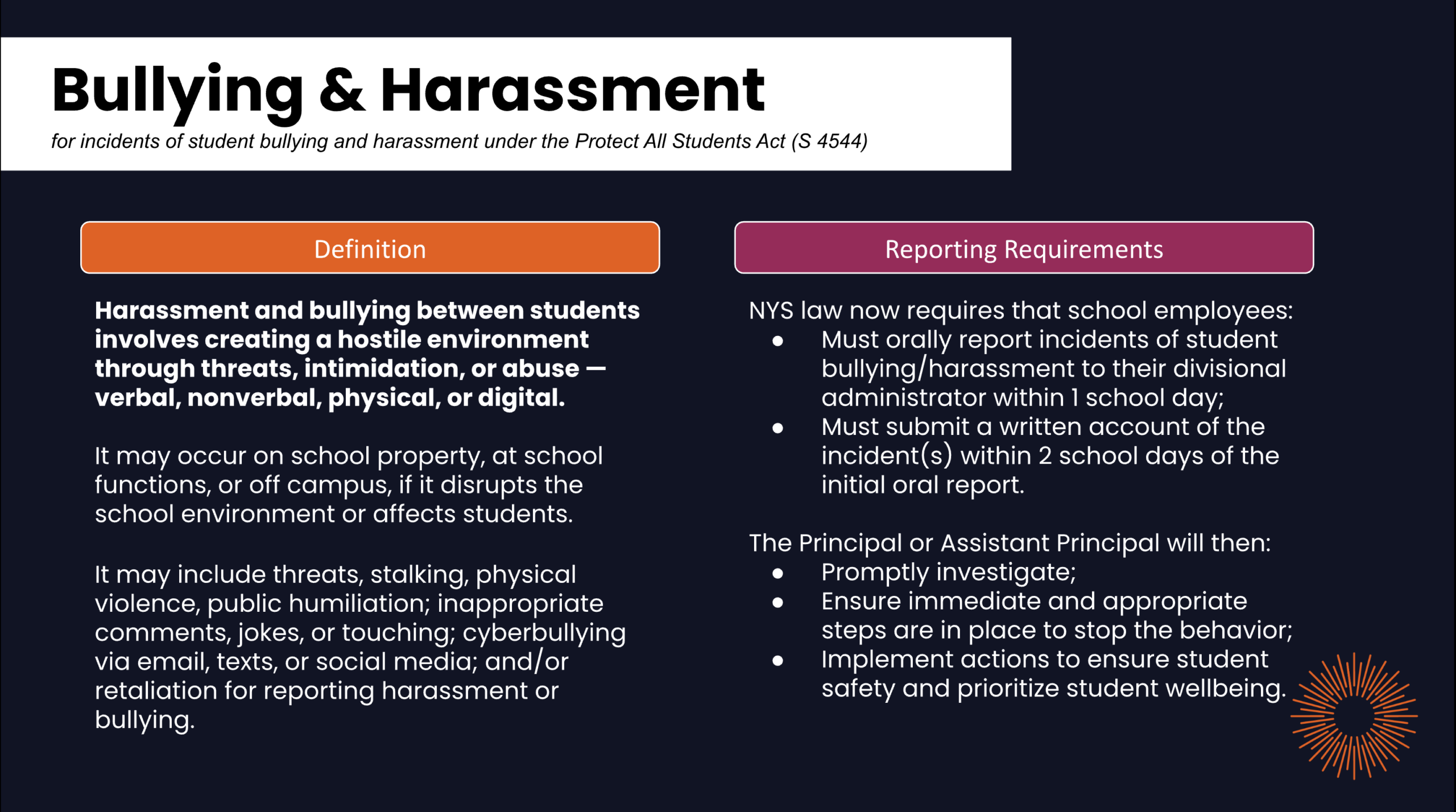
Under the Reid Law, employees who witness harassment or bullying or receive a report of harassment or bullying, must orally notify the head of school (or their designee) or the principal no later than one school day after witnessing the conduct or receiving the report, and they must follow up with a written report within two school days after making the oral report.
Heads of school (or their designees) or principals must promptly investigate any report of harassment or bullying. They must then communicate their findings with the victim(s), as well as take immediate steps and follow up in a manner reasonably calculated to 1) ensure the safety of the student(s), 2) ensure that such conduct has stopped, and 3) protect against retaliation.
Additional information is available here.
Medical Conditions
Action Plan and Form
If your child has been diagnosed with an allergy, it is critical that parents and guardians complete the ECFS Allergy Form. The information provided in this plan will provide your divisional nurses with standing orders from your child’s physician for both routine care purposes and for managing anaphylactic shock.
This information includes:
- Type of allergy
- Child’s weight
- Child’s typical response to the allergen
- Qualifiers for the administration of epinephrine
When do the nurses need my child’s prescription medication?
Prescription medication used for acute asthma attacks emergencies or during the routine course of the school day should be provided to the divisional nurse’s office no later mid-September.
Can my child carry their own epi-pen?
Students in Fieldston Middle and Fieldston Upper who have been determined to be independent administrators by their parents and physician can carry and self-administer their epinephrine auto-injectors.
Students in Ethical Culture and Fieldston Lower students are not permitted to carry prescribed epi-pens until determined by parents, your child’s physician, and the school nurse.
Clarity Program
Lunch from Home
Self Service Stations
Nut-Free
Employee Resources Under Education Law §921-a
Action Plan and Form
If your child has been diagnosed with asthma, it is critical that parents and guardians complete the ECFS Asthma Form. The information provided in this plan will provide your divisional nurses with standing orders from your child’s physician for both routine care purposes and for managing acute asthma attacks.
This information includes:
- The type, dosage, and indications for medication administration;
- Repeat or supplemental administration;
- Exercise information;
- Self-administration information.
When do the nurses need my child’s prescription medication?
Prescription medication used for acute asthma attacks emergencies or during the routine course of the school day should be provided to the divisional nurse’s office no later than Friday, September 20, 2024.
Can my child carry their own inhaler?
Students in Fieldston Middle and Fieldston Upper can carry and self-administer their meter-dosed inhalers when granted parent permission on their Asthma Form. By granting your child permission, the parent certifies that the child is an independent administrator of their medication including timing and technique and assumes all liability related to its use.
Students in Ethical Culture and Fieldston Lower students are not permitted to carry prescribed inhalers until determined by parents, your child’s physician, and the school nurse.
Stock Albuterol
Off-Campus Trips
Spacers
Action Plan and Form
Students exhibiting cold, flu, or gastrointestinal symptoms should follow the standard schedule for returning to normal activities as determined by their physician and ECFS policies.
At a minimum, regardless of COVID-19, students will always need to remain home for at least 24 hours without the use of fever-reducing medication following a fever of greater than 100 degrees by mouth or vomiting.
Please report any positive flu tests, strep tests, or acute illnesses to your divisional nurse. Additional information on the flu is available here.
What over-the-counter medications are available at ECFS?
Students may receive cough drops, antibiotic ointment, antacid (Tums), ibuprofen (Advil/Motrin), acetaminophen (Tylenol), Diphenhydramine HCL (Benadryl), hydrocortisone cream, pramoxine HCL (Caladryl Lotion), or sunscreen.
OCT medications may only be provided with written authorization from both the child’s parent/guardian and physician. This is New York State law, not an ECFS decision.
Action Plan and Forms
Concussions and head injuries are commonly reported injuries in children and adolescents and can have serious consequences if not managed properly. The School has partnered with New York University Langone Health (NYULH) to develop a Concussion Management Policy to support the proper academic management of concussions.
A concussion is a type of traumatic brain injury, or TBI, caused by a bump, blow, or jolt to the head or body. This sudden movement can cause the brain to move in the skull, creating chemical changes in the brain and sometimes stretching and damaging brain cells. It is important to recognize that even what seems to be a mild bump or blow to the head can be serious. Most concussions occur without loss of consciousness and some students may not experience and/or report symptoms until hours or days after the injury.
Concussions are serious and potentially life threatening. Medical management of concussions is evolving and we aim to safely return students to academics after injury. To accomplish this, we have established a policy that aids in the return to academics’ procedures after sustaining a concussion. This policy will be reviewed by the Ethical Culture Fieldston School Concussion Management Team and the New York University Langone Health Concussion Management Team on an annual basis.
Guidelines from the following national and international medical organizations served as resources:
- CDC Heads UP/U.S. Dept. of Health & Human Services, National Center for Injury Prevention & Control March 9, 2021
- SCAT5 Br J Sports Med: first published as 10.1136/bjsports-2017-097506SCAT5 on 26 April 2017
- NYSED Guidelines for Concussion Management in Schools 2018, NY State Department of Health
- “A School Administrator’s Guide to Academic Concussion Management.” Nationwide Children’s Hospital. June 2019
Return to Sports
Please note that the Return to Sports Concussion Management Policy varies slightly from the Return to Academics policy displayed on this page. The Return to Sports Policy is administered through the Athletic Department’s Athletic Trainer’s Office and is available here.
Concussion Management and Awareness Act “CMAA”
On November 22, 2022, Governor Hochul signed into law Bill S973, which amends the Education Law by requiring private schools to abide by the mandates of the Concussion Management and Awareness Act (“CMAA”) of 2011. Under the new law, New York private schools must comply with the same concussion management protocols and standards that public schools have followed for the past decade.
Broadly speaking, the CMAA imposes several key requirements.
- First, schools must provide a course of instruction on concussions and appropriate responses to suspected concussions. This course of instruction must be taken every two years by all school coaches, physical education teachers, nurses, and athletic trainers. The course must detail certain topics, such as the definition of a “concussion”, the various signs and symptoms associated with mild traumatic brain injuries, and the process for returning to activities following a concussion.
- Second, schools must provide information regarding concussions on any parent/guardian consent form which is required for a student’s participation in interscholastic sports. The consent form, like the course of instruction, must define a “concussion,” detail the signs and symptoms of these injuries and provide guidelines for returning to activities following a concussion.
- Third, the CMAA imposes a rule that a student must be immediately removed from any further athletic activity when it is believed (s)he sustained a concussion. Even where the school has doubts as to whether a concussion was sustained, it must err on the side of caution and immediately pull the student from the activity. Further, students suspected to have sustained a concussion must not return to any athletic events until they have seen a physician, been cleared by that physician, and remained symptom-free for at least 24 hours. Lastly, following a student’s concussion, the school must adhere to the recommendations of the physician with regard to the reintegration of the student back into the classroom and athletic activities.
Coronavirus disease 2019 (COVID-19) is the official name given by the World Health Organization (WHO) to the disease caused by SARS-CoV-2, the coronavirus that surfaced in Wuhan, China in 2019 and spread around the globe.
People who have been infected with COVID-19 respond in different ways—some report mild symptoms or no symptoms at all. Others experience severe symptoms and may be hospitalized from the disease.
Efforts to mitigate the disease have included “social distancing,” masks, and stay-at-home mandates. By early 2021, scientists had developed effective vaccines, and countries around the globe were focused on quickly vaccinating as many people as possible. But there was more to learn, especially with the identification of new SARS-CoV-2 variants (new strains based on mutations in the sequence of the genetic code of the original virus). Meanwhile, approaches to treating the disease are still evolving.
Isolation and Quarantine
Isolation for Positive Individuals as of 03/01/2024
As a result of significant decreases in the number of hospitalizations and deaths from COVID-19, the Centers for Disease Control and Prevention has made changes to guidance related to COVID-19.
Individuals who test positive for COVID-19 no longer need to stay in isolation for five days. Instead, individuals may return to normal activities if their symptoms are mild and improving and it has been 24 hours since the individual’s last fever, without the use of fever reducing medications. A negative test is not required to return to normal activities.
Upon return to normal activities, individuals are recommended to remain cautious by wearing a mask and keeping a distance from others.
Quarantine for Exposed Individuals as of 03/01/2024
There are no requirements for exposed individuals. Recommendations emphasize that people should still try to prevent infections in the first place, by getting vaccinated, washing their hands, and taking steps to bring in more outdoor fresh air.
Additional information is now available under the CDC’s Respiratory Virus Guidance which includes flu and RSV.
Symptoms
People with COVID-19 have had a wide range of symptoms reported – ranging from mild symptoms to severe illness. Symptoms may appear 2-14 days after exposure to the virus. Anyone can have mild to severe symptoms. Possible symptoms include fever or chills, cough, shortness of breath or difficulty breathing, fatigue, muscle or body aches, headache, new loss of taste or smell, sore throat, congestion or runny nose, nausea or vomiting, and diarrhea.
Mitigation Strategies
Archived Plans
A Guide to Reopening Our School was originally created in July 2020 to provide our lower schools, middle school, and upper school, as well as their employees, contractors, students, and parents/guardians with precautions to help protect against the spread of COVID-19 during the 2020–2021 academic year. In anticipation of the 2021 – 2022 school year, we issued an update intended to align our operations with the most recent recommendations and guidance on how to prioritize safe in-person learning while adhering to layered mitigation strategies.
These two reopening plans were developed in accordance with the New York State Department of Education Health and Safety Guide for the 2021-2022 School Year, the Centers for Disease Control and Prevention (CDC) Guidance for COVID-19 Prevention in K-12 Schools, the Interim NYSDOH Guidance for Classroom Instruction in P-12 Schools During the 2021 – 2022 Academic Year, the NYSDOH Updated Isolation & Quarantine Guidance, and the New York City Department of Health and Mental Hygiene COVID-19 Health and Safety Information for New York City Nonpublic and Charter Prekindergarten (Pre-K) to Grade 12 Schools with additional information from the American Academy of Pediatrics (AAP).
A Guide to Reopening Our School 2021 – 2022
New York State Report Card 2021–2022
A Guide to Reopening Our School 2020 – 2021
New York Forward Safety Plan 2020–2021
Action Plan and Forms
Substitute Nurses
Off-Campus Trips
Independent Students
Pump Malfunctions
School Bus
Supervised or Nurse-Dependent Students
Action Plan
The head louse, or Pediculus humanus capitis, is a parasitic insect that can be found on the head, eyebrows, and eyelashes of people. Head lice feed on human blood several times a day and live close to the human scalp but are not known to spread disease. Additional information about head lice may be found on the Centers for Disease Control and Prevention’s website.
Head lice are spread most commonly by direct head-to-head (hair-to-hair) contact. However, much less frequently they are spread by sharing clothing or belongings onto which lice have crawled or nits attached to shed hairs may have fallen. The following are steps that can be taken to help prevent and control the spread of head lice:
- Avoid head-to-head (hair-to-hair) contact during play and other activities;
- Discourage your child from sharing clothing such as hats, scarves, coats, sports uniforms, hair ribbons, or barrettes;
- Do not share combs, brushes, or towels;
- If your child has a sleepover, it is important for you to check for nits/lice when they return home, and regularly thereafter;
The best way to prevent an outbreak of head lice is to check your child’s head/hair frequently for any signs of head lice. The earlier a case is detected, the easier it is to treat, and the less likely it is to spread to other households. We encourage parents to check their children, particularly if they are scratching their heads or complaining of itchiness of the scalp.
If you identify nits or head lice on your child, please contact your child’s primary care physician for treatment guidance and notify your divisional nurse’s office.
Will my child be sent home if head lice are found?
While families are encouraged to pick up their child when notified, students diagnosed with live head lice will not be required to go home early in most cases. Students can go home at the end of the day, be treated, and return to class after appropriate treatment has begun. Nits may persist after treatment, but successful treatment should kill crawling lice.
Your divisional nurse may provide hair ties for those with long hair so hair may be put up. The divisional nurse may also provide hats to the child if desired by the family. Depending on the severity, the perversity of symptoms, and in the nurse’s best clinical judgment, students may be sent home if conditions require.
Does ECFS adhere to a “no nit” policy?
No, both the American Academy of Pediatrics (AAP) and the National Association of School Nurses (NASN) advocate that “no-nit” policies should be discontinued. “No-nit” policies that require a child to be free of nits before they can return to school should be discontinued for the following reasons:
- Many nits are more than ¼ inch from the scalp. Such nits are usually not viable and very unlikely to hatch to become crawling lice, or may in fact be empty shells, also known as ‘casings’.
- Nits are cemented to hair shafts and are very unlikely to be transferred successfully to other people.
- The burden of unnecessary absenteeism to the students, families, and communities far outweighs the risks associated with head lice.
- Misdiagnosis of nits is very common during nit checks conducted by nonmedical personnel.
When a Case is Detected
Diagnosis
Returning to School
Screening
Symptoms
Transmission
For Children
For Parents/Guardians
Action Plan and Form
If your child requires prescription medications during the course of the school day, it is critical that parents and guardians complete the ECFS Prescription Medication Form.
The legal requirements listed below for the administration of prescription medication to students by the school nurse or designee must be followed.
- A prescription form (original or photocopy) for medication from a licensed prescriber stating the student’s name, medication, dosage and approximate time to be given.
- The medication must be in the original pharmacy labeled container.
- Written permission by the parents or legal guardian for the administration of the medication.
Please note that students are not permitted to carry controlled substances in school.
Where can I learn more about prescription medication administration in schools?
Families are encouraged to read the NYSED Guidelines for Medication Management in Schools to understand the obligations of the school, students, and families as it relates to prescription medication administration, documentation, training, storage, and communication.
Can nonlicensed school staff administer medication?
Families are encouraged to review the Guide to Determining Levels of Assistance in Medication Delivery for additional information.
Pertussis or “whooping cough“ is a highly contagious bacterial illness that can spread through close contact when people with the disease cough. It causes a severe cough that can last weeks and even months, sometimes leading to coughing fits and/or vomiting. Pertussis is easily spread from person to person by coughing or sneezing. Anyone can get pertussis, but it can be dangerous for infants, pregnant women, and people with weakened immune systems.
Symptoms can appear five to 21 days after infection. Pertussis may start with cold-like symptoms (i.e., sneezing/runny nose) followed by a cough that can gradually become worse. Others may develop the cough without any cold symptoms at all. Those with pertussis are most contagious during the beginning, cold-like stage and the first two weeks after cough onset. Coughing in very young children may produce a whooping sound due to trying to catch their breaths, but this is rare in older children. There is generally no fever, and coughing may last four weeks or longer. Adults, teens, and vaccinated children often have milder symptoms that may be confused with bronchitis or asthma.
What if my child begins to cough?
If your child begins to develop cold symptoms followed by a cough, the New York City Department of Health and Mental Hygiene (NYC DOHMH) recommends that you:
- Keep your child home from child care, school, and activities such as sports or play groups.
- Make an appointment with your child’s physician as soon as possible and tell the doctor that your child may have been exposed to pertussis.
- Report possible pertussis infections to your divisional nurse.
- If the doctor states that the child does not have pertussis despite coughing, please ask for a note informing the School of the negative test results.
The most accurate test for diagnosing pertussis is a swab placed through the nose. Antibiotics given early may minimize severe symptoms and prevent further spread of the disease.
Letter to Provide to Child’s Physician
Click Here to Visit the CDC’s Website for More Information
What if my child or household is high risk?
What if my child is diagnosed with Pertussis?
My child has a medical exemption for DTaP or Tdap.
What can we do to prevent the spread of Pertussis?
Information from the Mayo Clinic
What does Whooping Cough sound like in young children?
Action Plan and Form
If your child has been diagnosed with a seizure disorder, it is critical that parents and guardians complete the ECFS Seizure Action Plan. The information provided in this plan will provide your divisional nurses with standing orders from your child’s physician for both routine care purposes and for managing seizures on campus.
This information includes:
- When to call 911;
- When to call the child’s provider first;
- Any rescue therapy or emergency medications required;
- Post seizure care instructions;
- Seizure triggers and other special information.
When do the nurses need my child’s prescription medication?
Prescription medication used for seizure emergencies or during the routine course of the school day should be provided to the divisional nurse’s office no later than Friday, September 20, 2024.
What should we do if my child has a seizure for the first time mid-year?
Students who have a seizure for the first time during the school year should seek assessment and treatment from your their primary care physician or neurologist. Students may not return to school until your divisional nurse receives a note from your child’s primary care physician clearing them to return and a completed Seizure Action Plan.
Will the school nurse administer Diastat as needed?
Students who are prescribed Diastat or diazepam will be administered this medication by the school nurse in accordance with their provider’s orders.